Showing posts with label beginner. Show all posts

Thursday, February 05, 2015

New Beginner's Project - Make a Mallet

I am getting tired of cleaning the workshop, which is not to say I have stopped, just gotten bored with it. However, it does go on, and on and on and - you get the picture. Sometimes I think I could be a hoarder, but then the whole thing gets to me and I clean up whatever I can.

Anyhow, as I was looking through some of the stuff on the computer, I found some pictures I had taken a while ago on making a woodworker's mallet, one of those things we keep around the shop for swatting the piece of wood that won't move and that sort of thing.


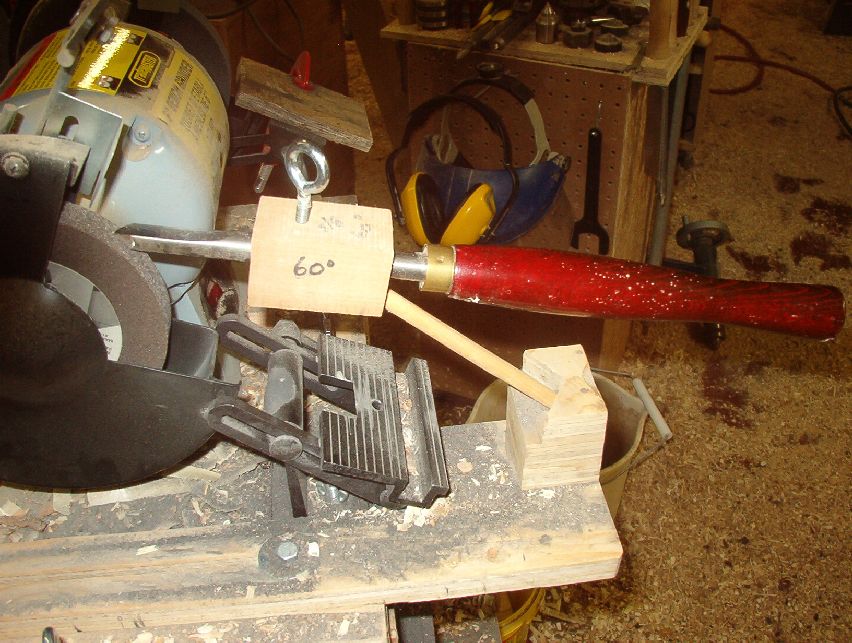
Anyway the project is up at Workshop Mallet. This is one of the exercises in Milton and Wohler's book but there it is just a measured drawing. It is a good beginner's project although I find it a useful thing in the workshop as well. The jaws I make for my OneWay chuck are a neat rig for getting the handle set right in the head. Take a look.

Wednesday, August 17, 2011

Choosing A Wood Lathe: Accessories Can Make All The Difference


   Buying a wood lathe is different than purchasing almost any other stationary power tool. Most come ready to use right out of the box or with only a bit of assembly such as mounting the enclosed blade. Wood lathes generally come without cutting tools of any kind. All that come with the lathe are a faceplate and a couple of centers for mounting wood. However, tools and accessories are readily available and are either needed for turning or will add tremendously to the enjoyment. Still, it is necessary to make sure the desired accessories fit your lathe as it is definitely not a one size fits all proposition.
   A good beginner's set of tools will meet most of the needs of beginning and intermediate spindle turners. Generally a bowl gouge or an Oland tool must be purchased or made for spindle turning. Ensure that the tools are high speed steel and have comfortable handles. While a small set of tools makes it hard to turn large objects and a big set makes it hard to turn small ones, a medium sized set with shafts about seven inches long are commonly used for all sorts of sizes of turnings.
   The typical shop grinder is easily turned into a sharpening station with a couple of aluminium oxide wheels and a sharpening jig. While some experienced turners disdain the sharpening jigs, others love them and they make life much nicer for beginners.
   Accessories will include more centers and faceplates as well as various chucks and gadgets. Manufacturers have long ago noticed the buying power of wood turners and the near addiction to acquiring tools expressed by many. It is necessary to know some things about your lathe before buying.
   Generally accessories will attach to the headstock or tailstock. Headstocks come in a variety of sizes expressed in terms of their diameter and screw size expressed as teeth per inch or tpi. Common sizes for beginner length are one inch diameter by eight teeth per inch and three quarter inch diameter by sixteen teeth per inch. Accessories are easily available for both but may not be for some other sizes. In the UK metric sizes may be more prevalent.
   Tailstocks and headstocks will generally be bored through and then tapered, usually to a standard called the Morse taper. This will generally be a number one or number two Morse taper expressed as #1 or #2. The two are not interchangable but most accessories will be available in either size. These have been the industry standard for some time. Number three Morse tapers have been used on metal lathes for a long time and are being found more often on some of the larger wood lathes for sale.
   It should be noted that having a set of accessories that meet the accepted industry standards allow them to be moved on to new lathes. A good place to start is a beginner lathe with a one inch by eight tooth per inch headstock and number two Morse tapers in the headstock and tailstock. Such standards can have a woodturner looking at the after market accessories for a long time to come.

Thursday, April 14, 2011

Basic Equipment You Will Need to Start Woodturning Projects

 While it is easily understood that a wood lathe is needed to begin woodturning projects, there are a few other necessities before starting. Many of these are already found in the typical woodworking shop while others will need to be purchased.

The basic wood lathe comes with one or two faceplates for bowls and other large work; a spur center and tail center for holding spindle projects; and a couple of tool rests for different sized work. No cutting tools are generally supplied with the lathe.
While experienced turners will purchase individual tools, it is advisable for the beginner to get a beginning set. This will contain the necessary tools for spindle work. Usually this will be a roughing gouge, a couple of spindle gouges of different sizes, a couple of skews of different sizes, a couple of scrapers of different sizes and a parting tool. Such a set should be high speed steel, not carbon steel which is cheaper but does not hold an edge very long compared with high speed. Later on bowl and faceplate tools can be purchased or made. If the beginner is anxious to begin turning bowls, a one quarter inch bowl gouge will get them started and different sizes can be purchased later on.
Once the tools are purchased there needs to be a means to sharpen them. Woodworkers new to woodturning will be amazed at how often turning tools need to be sharpened. The usual means to a good edge is a grinder however most shop grinders have wheels too coarse to give a good edge on high speed steel. An aluminum oxide wheel of appropriate size should be purchased. It should be around eighty grit and a wheel dresser to keep it round and clean is really a necessity.
While some turners consider a sharpening jig to be a luxury, for a beginner it is almost a necessity. Sharpening woodturning tools freehand is a skill in its own right if not an art. Learning it at the same time as trying to learn woodturning is difficult and learning to turn with dull tools is almost impossible. A jig should be purchased or made at the very beginning.
One of the things that makes woodturning special is the ability to much of the time sand and finish a project on the lathe. Sandpaper in grits from eighty to two hundred twenty is usually found in the workshop but some turners like to go as high as two thousand grit for some projects. Generally up to three hundred twenty will be fine. Danish oil and similar finishes work well for most woodturnings and again is a typical supply of most shops.
Safety is an important part of any woodworking shop and work around a wood lathe is no exception. A face mask to protect from flying wood is a necessity as is a dust mask to protect the lungs from sanding. Hearing protectors are good to have. Most lathes are fairly quiet but saws, drills, sanders and dust collectors as well as other shop tools can cause hearing problems.
Tools to ready the wood for the lathe will likely be already in the shop. Bandsaws and table saws are often used and a chainsaw is a part of most woodturner's arsenals of tools.
A quick look at a woodturning catalogue will convince any aspiring woodturner that bits and pieces can be acquired for years to come but these should get one started. Certainly a lot of enjoyment are contained in these few simple items.

Thursday, February 24, 2011

Choosing A Wood Lathe: Remember The Budget

Buying a wood lathe sounds like a simple proposition. Check the budget, look at the lathes in the budget category, choose the one that seems good and away we go. However, like most things in life, it is not that simple. One of the more difficult things for the beginner or first time buyer, is knowing how to gauge the budget in the first place.
Wood lathes are more individual than many other woodworking tools. While there are certainly many models of tools such as table saws, for example, there are certain features expected in particular price ranges and the saws will be fairly uniform in that range. It is expected that one may purchase one, put it in the work shop, and go to work. The wood lathe is a different proposition.
While most wood lathes in a given price range will generally be similar in quality this is not always so. A mini lathe will usually be better quality than a full size lathe in the same cost bracket, for instance. Two lathes of the same price may have different mechanisms for controlling speeds and overall quality of the lathe with the more expensive speed controller will likely be less than that of the other machine. It is necessary in the budget to question what is wanted in the lathe for weight, quality of construction, type of speed control and size among other things.
All other things being equal among lathes, there is the extra strain on the budget to consider. That table saw will be ready to work right out of the box, but not so for most lathes. The typical wood lathe comes with the basic machine ready to run and with centers and a faceplate to hold the wood, but without tools to cut the wood nor any means to keep them sharp. Again in contrast to the table saw that came with a blade that rarely needs sharpening and then by a professional shop, the lathe comes with no tools and no means to sharpen them even though they will need frequent sharpening. It often comes as a surprise to a beginning wood turner that in some circumstances tools need to be sharpened every couple of minutes.
So the budget will need to stretch to a set of woodturning tools, a grinder and a set of aluminium oxide wheels at the very least, not to mention sundries like sandpaper and finishes. All of these should be allowed for in the budget before shopping for the wood lathe. It should be noted that a decent set of woodturning tools or a four jaw chuck may each be more expensive than a beginner's wood lathe.
It is possible to get started turning wood on a modest budget. Some reasonable planning is necessary but many woodturners have begun on light lathes and used them for many years.

Tuesday, November 04, 2008

Thnks to the Old Timers

Maybe "Old Timers" is a poor phrase to use here. many of the old time turners are not old. Some of them have only have only been turning for a year or two. What makes them "old timers" is simply that they have been turning wood longer than others.

However, what sets woodturning apart from most other crafts is the desire to share information. Old Timers are more than willing to bring a new comer under their wing and get them started on woodturning addiction. There is a sense of camaraderie that needs to be extended into more parts of life.

Most of our woodturning meetings have a couple of sharing times. During one, someone who is advanced in a technique shows the rest of us how they do it. Another more informal sharing time is the show and tell. People who have been turning for a few weeks or a lot of years bring in their latest pieces and talk about how they made them. Comments are almost always encouraging and often the old timers will quiz the new guys on how they did something.

questions, encouragement, sharing, friendship, humility

Who would NOT want to be a part of this? Maybe this is why a number of our club do not turn, they just like the meetings.

Tuesday, October 28, 2008

Sharpening, Once Again

I have been catching up on my emails to be answered and one question that comes up over and over again is that of sharpening. Really this is not surprising. After all, dull woodturning tools make for lousy and frustrating woodturning. Add to this the prevailing argument over free hand or jig sharpening and you either get a frustrated newbie who

  1. can not get the hang of freehand sharpening that we who have turned for a while learned after only two or three years
  2. decides the only way to go is to get a jee whiz bang jig and then finds out that it adds a hundred or two to his after lathe cost of tools, grinder, special wheels, sanding pads, and whatever else
Years ago I built my $2.50 sharpening jig with the understanding that if it worked well for me, I would get a commercial one. You see, I was not convinced that I wanted to go from free hand to jig sharpening. The jig worked so well that I never got around to replacing it. One of these days I may, in a fit of energy, remake it in metal, but I doubt it. It works so well, why fix it?


jig with spindle gouge

There are not so much plans since every grinder is a bit different, but rather a discussion of building with photos over at sharpening jig. If you keep going to the last page there are videos of it working. For a couple of bucks, it is worth a shot.

Hope it helps. Keep turning.

Monday, October 27, 2008

New Video in the works

Sorry to be so long in posting. I am working on it as life settles down into the new church, a different schedule for karate, and less time at the lathe. A question that has been raised to me a few times now is where to begin turning?

By this most woodturners to be seem to wonder if they should start by making table legs or spurtles or bowls or whatever. I think the best thing to start with is making a stick and a bunch of shavings. In fact, I think it is good for an experienced turner to make a stick and a bunch of shavings every now and then.

It teaches us or reminds us from whence we come. Take a log and mount it onto the lathe between centers and start removing stuff. First a rough object is reduced to a smooth one. The features of the log are revealed; knots, weak wood, insect holes and the like. Practice is given in entering at a precise place, cutting downhill with the grain, riding the bevel and so on.

Besides, this is fun and a lot of shavings are obtained for the compost pile.

I have shot the footage of me turning down a 10" diam by 16" log and should have it edited and uploaded soon. I will let you know.

Tuesday, January 01, 2008

Happy New Year


Time just keeps moving on and I seem to play catch up a fair amount of it. While checking the web site for a major rewrite, I found a couple of projects or at least the bones of them, that have not as yet been put up. So I managed to get a beginner project up on the site. It is based on the Milton and Wohlers book that is also on site. Eventually I will have instructions for most of those projects. Some are pretty dated but they all teach the skills of wood turning.

This project gives a handy tool for the shop, a scratch awl. I think the ferrule and striker cost me about 5 cents so you can make a few to keep them handy. The pages are over at scratch awl project

All the best to you and yours. Keep the turning turning. I will try to get the video for this shot and up shortly.