Showing posts with label lathe. Show all posts

Wednesday, August 17, 2011

Choosing A Wood Lathe: Accessories Can Make All The Difference


   Buying a wood lathe is different than purchasing almost any other stationary power tool. Most come ready to use right out of the box or with only a bit of assembly such as mounting the enclosed blade. Wood lathes generally come without cutting tools of any kind. All that come with the lathe are a faceplate and a couple of centers for mounting wood. However, tools and accessories are readily available and are either needed for turning or will add tremendously to the enjoyment. Still, it is necessary to make sure the desired accessories fit your lathe as it is definitely not a one size fits all proposition.
   A good beginner's set of tools will meet most of the needs of beginning and intermediate spindle turners. Generally a bowl gouge or an Oland tool must be purchased or made for spindle turning. Ensure that the tools are high speed steel and have comfortable handles. While a small set of tools makes it hard to turn large objects and a big set makes it hard to turn small ones, a medium sized set with shafts about seven inches long are commonly used for all sorts of sizes of turnings.
   The typical shop grinder is easily turned into a sharpening station with a couple of aluminium oxide wheels and a sharpening jig. While some experienced turners disdain the sharpening jigs, others love them and they make life much nicer for beginners.
   Accessories will include more centers and faceplates as well as various chucks and gadgets. Manufacturers have long ago noticed the buying power of wood turners and the near addiction to acquiring tools expressed by many. It is necessary to know some things about your lathe before buying.
   Generally accessories will attach to the headstock or tailstock. Headstocks come in a variety of sizes expressed in terms of their diameter and screw size expressed as teeth per inch or tpi. Common sizes for beginner length are one inch diameter by eight teeth per inch and three quarter inch diameter by sixteen teeth per inch. Accessories are easily available for both but may not be for some other sizes. In the UK metric sizes may be more prevalent.
   Tailstocks and headstocks will generally be bored through and then tapered, usually to a standard called the Morse taper. This will generally be a number one or number two Morse taper expressed as #1 or #2. The two are not interchangable but most accessories will be available in either size. These have been the industry standard for some time. Number three Morse tapers have been used on metal lathes for a long time and are being found more often on some of the larger wood lathes for sale.
   It should be noted that having a set of accessories that meet the accepted industry standards allow them to be moved on to new lathes. A good place to start is a beginner lathe with a one inch by eight tooth per inch headstock and number two Morse tapers in the headstock and tailstock. Such standards can have a woodturner looking at the after market accessories for a long time to come.

Friday, June 03, 2011

Choosing A Wood Lathe: Make Sure The Tool Fits The Shop


  Wood lathes are generally substantial tools that are going to be part of a general woodworking shop. As such, some consideration needs to be given to ensure that they fit the shop well. At least three areas need to be looked at, namely the type of the shop, the size of the workshop and the woodturner concerned.
  Woodworking shops come in a variety of shapes, sizes, and characters. Either form the beginning or over time they develop a personality depending on the work that is done in them. As woodturning either develops in them or is introduced, they ten to fit three large groups. One is the furniture shop, another an all purpose wood shop, and finally the dedicated woodturning centre.
  For the furniture shop, a wood lathe will likely be used to turn both small items such as speciality door knobs and larger items such as table legs. A typical lathe for this shop would be one that can turn a twelve inch diameter spindle up to thirty eight inches long. It needs to be remembered that small items such as those door knobs can be turned on a large lathe but a large item can not be turned on a small lathe. The capacity to make a sturdy bench for the lathe is inherent in a furniture shop and it can be produced to hold a lot of the tools and accessories needed for turning wood.
  The all purpose wood shop will likely want a similar lathe to the furniture shop but may want it to be able to turn larger pieces. Many of today's lathes allow for the headstock to swing and handle large pieces for outboard faceplate work. If this is desired, it is a good idea to get a lathe that will have a minimum speed of four hundred revolutions per minute or even lower to reduce vibration.
  The dedicated woodturning centre will need at least the second type of lathe and may be better served with a family of lathes that allow for various work to be going on at various times. One lathe may be dedicated to spindle work while another without ways is designed for faceplate work alone. Still another mini lathe may be available for small work at high speeds.
  With these considerations comes the need for the lathe or lathes to fit the shop. Not only does a larger lathe require more floorspace for its footprint, it also needs a fair amount of room around it for the woodturner to move in safety while turning. It will also need to fit itself around the other tools to give a good feel to the shop work flow.
  Finally, every woodturner will develop his or her own style and desire of woodturning. While the first lathe will seldom truly reflect this except by chance, the second and subsequent lathes can be chosen to make the preferred choices in wood turning more enjoyable and perhaps safer as well.
  Wood lathes are tools that tend to be a part of the woodworking shop for a long time and due consideration should be given to their purchase. It is an opportunity for reflection on our craft and in itself can be an enjoyable part of the process.

Friday, February 22, 2008

work in progress: burl on the lathe


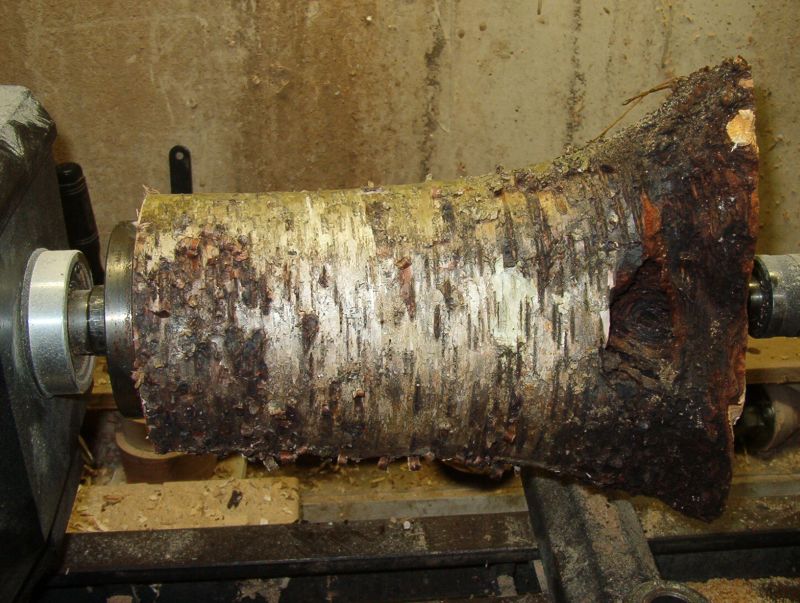
I managed at last to get a chance to get a couple of pictures and thoughts up about the first spruce burl. It is about 10" x 10" but will likely produce an 8" hollow form given the vagaries of burls. So far I have been able to make some design decisions and find out some of the difficulties it will throw at me. I expect to use the regular hollowing tools for this one, but it has introduced some interesting problems in mounting. The wood is soft and displays some of the common punky and spalted woods that are often found in spruce burl. On the other hand, it also has some of those bark inclusions, sap pockets and incurves that make these so much fun. Challenges are only design opportunities after all.
starting the burl

Friday, January 25, 2008

Back to Basics


I have been working on some things for the new website in answer to questions specifically from beginners. More and more I am convinced that we need to get back to the fundamentals of turning. In some ways the direction of turning today seems to reflect the direction of education.

Our educational system in North America appears to be ranging away from the fundamentals of societal need to move toward specialization without foundation. By that I mean for example that students are preparing term presentations with video cameras before they can write a script, or for that matter a coherent sentence. Algebra appears to be on the curriculum for students who cannot handle basic arithmetic without a calculator. It used to be that employers considered a high school graduate suitable for training for managerial positions. Now they hope that college graduates can read, write, and balance a check book, but there are no guarantees. Many colleges and universities have entry level courses, mostly non credit, to teach the basic skills of reading, writing and arithmetic to incoming students, some of whom were A level graduates of high schools but lack basic skills.

In the same manner, I hear people having bought lathes to turn salad bowls for a living or baseball bats for the team, but have never used the machine before. Many a would be turner goes to the lathe for the first time, puts on a length of construction 4x4, and watches his tool be kicked over his head by a whirling menace. Fundamentals are necessary to learn and practice. The old adage of "walk before you run" works well here.

Wood turnings all work alike; prepare, turn, sand, and finish. The preparation may range easily from chainsaw and log to band saw and board or drill press and pen blank, but wood must be prepared to go on the lathe. Segmented turners will cut and glue for ages but it is all to prepare the wood to go on the lathe.

Turning may be for spindle or faceplate work but tools are still needed to be sharp and presentation needs to be clear. Different woods cut a little differently and need to be learned and approached in their own manner. Too many a new turner has been discouraged with the common spruce or pine of the flat worker to later be amazed at the nice cutting qualities of a piece of maple or ash. Each style of tool requires a slightly or greatly differing approach, but they are all able to be learned and familiarity with one makes the next easier.

Sanding is as important to the wood turner as to any other wood worker. The person who looks at the final piece looks at the surface, not the work in it. Finishing can be as elaborate or as simple as one likes, providing it fits the piece. Some call for dyes, painting, carving, piercing, pyrography or a combination of these and other embellishments. For others it would be gilding the lily.

The fundamentals well learned will let us approach that beautiful piece of hideously rare and possibly expensive wood with confidence. Learning is good.

Monday, December 03, 2007

Roughing a Bowl, Video 7; turning the inside (a)


I know this is dragging out but it takes ages to get a decent video out especially being the amateur I am. Besides, YOuTube only lets me put up so much in one clip and it is the easiest way to get the stuff out that I have seen so far. I will eventually get some of these on a file for download to a CD or DVD if anyone is interested.
The bowl is continuing on. Unfortunately for me, clearing the inside is one of the fastest parts of roughing a bowl and is also one of the most fun. This five minute clip in real time flips the bowl to remount, measures the sides and bottom for good drying and narrows the tenon for later release. The tools used are a 3/8" and 1/4" Oland. This is likely one of the reasons that I have a lot of bowls waiting to be refinished but that is a later project time and another video.

One of the things I have in mind is a set of short videos on Oland tool cuts, again if anyone is interested. At present I am in the beginning stages of video and pictures of a Wood Turning Basics web book based on the Milton and Wohlers text and I will bounce back and forth from doing that and other projects for the next year at least until it is done.

Anyway, enjoy the video or at least watch it and as always, any comments are welcome.

Saturday, December 01, 2007

Roughing a Bowl, Video 5: Mounting on the Lathe


Here is the quick and easy video 5, mounting on the lathe. I like to mount a bowl between centers if at all possible for roughing cuts. It is quick and easy and allows for the wood to be moved later if necessary. The big negative for me is the tendency for the spur bit to pretend it is a spade bit and try to drill its way through.Since this just means tightening the tail stock on a periodic basis, this does not really matter.

Friday, October 12, 2007

Tools for a Beginner

As I was considering the roughing tool, I was also thinking of the perennial question of what tools a beginner should get, since most lathes come without tools. The following article has a few suggestions.

Wood Turning Tools: getting good ones may be beginner’s Luck

As wood turning has become more popular in recent years the manufacturers of wood working tools have developed a bewildering array of tools for the wood turner. This already bewildering array has become even more confusing for the beginner than for the experienced turner who has a few special tools that are used all the time. Beginners have yet to discover what direction their turning will take them and what tools to use on the journey.

Wood turning is split into two general fields, spindle and face plate turning. While most lathes come supplied with the rudimentary holding devices for the wood, they rarely come with cutting tools. A good, general, beginner’s set would include:


  • a 3/4" or 1" roughing gouge for making spindles round

  • a 3/4" or 1" skew for making those round spindles smooth

  • a 3/8" or 1/4" and a ½ “ spindle gouge for beads and coves

  • a 1/8" parting tool for separating work

  • a ½" to 1" round nosed scraper for some finish cuts

  • a 1" straight scraper for facing off some work

  • a 3/8" bowl gouge for face plate work


Most beginner sets on the market will have some combination of the above although they seldom have a bowl gouge included. Again, most beginners start with spindle turning and become proficient at it before attempting bowls. There is no particular reason for this and a basic bowl is no more difficult to turn than is the typical candle stick. While a 3/8" bowl gouge may cost as much as some beginner’s sets, an Oland tool suitable for the beginner and advanced turner alike is easily made in the home shop and a simple on-line search will bring up the directions for construction and use.

One of the greatest changes in wood turning tools in the last hundred years or so has been the metal used to make the tools. Unfortunately it has also become a source of confusion for inexperienced turners. There are three main groups of steel used for the tools; carbon, high speed, and powdered. The best buy for both beginners and experienced turners is M2 high speed steel, usually written as M2 HSS. Since this is also the most common type available it is easy to buy and a good deal. Carbon steel is harder to sharpen without losing its temper and powdered steel is likely overkill at a premium price.

The important thing to do is to get the tools and start making shavings. Some experience will develop a preference for certain tools in certain settings and will also develop a lot of enjoyment.

Once again feel free to post the article elsewhere as long as due credit is given.


&copy;Darrell Feltmate,<a href="http://aroundthewoods.com">Around the Woods (aroundthewoods.com)</a>; used by permission

will work well in the html code or just

©Darrell Feltmate, http://aroundthewoods.com, Around the Woods, used by permission

in straight text.

Friday, October 05, 2007

Wooden Spoon video (7)

One of these days I have to get my life in order. There are too many things to fill too few hours. Finally I got the last video up about turning the spoon. Next I have to get some prepared on carving the bowls, maybe. Along with sanding, this one has the parting off of the spoon from the lathe. I like to do this with a skew and I like to part from the drive spur. Simply, once the piece is cut from the spur drive it stops turning whereas, if the spur has forced into the piece too far or hard and you part from the tailstock, it keeps turning and you have an awkward moment of trying to turn the lathe off while holding the turning piece or of pulling the piece from the turning spur center. I am awkward enough without working on it to be more so.

Lately I have been turning a couple of whisk handles. This is a great beginner's project and I will get a page up soon.

Tuesday, October 02, 2007

Wooden Spoon Video Part (6)


As I continue on with the wooden spoon, the handle is finish turned and decorated with a couple of burn lines using a wire. Interestingly,as I look at the video again I realize that I have used the chuck for this spoon and somtimew "forgot" and simply turned between centers for others. What can I say, both methods work well. I often get asked by beginners about what chuck to buy, given the high cost. Generally, I point out that the chucks are very recent additions to at least a 3,000 year old craft and not really necessary. Nice but not necessary.

Saturday, September 08, 2007

Wood Turning Project: Table Lamp in Spalted Birch


Vacation is sort of underway. I anticipated doing a lot of wood turning for vacation including a 2 hour drive to see my folks and pick up an oak tree that a friend had to cut down. His description is of 2 foot thick and long blocks, but it has been down fo a while and it may be cracked. None the less, good wood is good wood and I do like a piece of red oak on the lathe. Shavings, wood lathe, turning, now that sounds like vacation time. Of course there is reality as well.
Does driving a van load (and I do mean load) of furniture 21 hours from Nova Scotia to Ontario and setting up my daughter's apartment count as vacation? While we were there my son got me to visit his kung fu school. I had to wring out my t-shirt after the workout.
Vacation? Now I am redoing a room in the house (remove the wall paper, mud and sand the walls, paint, remove the carpet, and put down laminate). Then there is the garage roof to shingle. Vacation is where you find it. Anyhow, I managed to get a page up dealing with turning a lamp for my daughter's apartment. There are no links to it as yet from "What's New" or the contents page but it is at Lamp Project
As always, any problems with the pages would be appreciated to be reported.

Saturday, August 25, 2007

Wood Turned Lamp


My youngest daughter is moving provinces for college and into her own apartment. She wanted a desk lamp so I turned one for her. We are moving her things up on Tuesday and will be gone for a week so I will not likely have time to get a web page up before then at Around the Woods, but I took some pictures as I went so I should be able to when I get back. This makes a great project involving faceplate and spindle turning as well as assembling a piece after turning. Since it also involves drilling a hole down the center of the lamp spindle, and at the center line of the base from edge to center, it adds a bit of complexity to the process. Besides, they make great gifts.

I turned it out of spalted birch that came from a silver birch I had to take down at my parent's cottage after it got lightning hit and was obviously not going to recover. So it has some special meaning to us as well. I think she will be happy with it.

Saturday, August 11, 2007

Wood Turning Tools

Lately I have found myself looking at the wood turning tools in some of the catalogs that we likely all get. The range of tools is a bit overwhelming for me and it must be a shock and a half for new wood turners. Still, with the exception of a few of the specialty tools, they all fit a couple of categories: roughing gouges, parting tools, spindle gouges, skew chisels, hook or ring tools, bowl gouges and scrapers. The rest seem to be choices of sizes and steels. There are a few variations in the shape or depth of gouge flute, and the argument over flat or oval skews seems to be in fine form, but really there does not seem to be a whole lot new. Over on the rec there has been a discussion over how many tools a turner uses and for most of us, once you get away from the size issue, we have a couple for bowls,a couple for spindles, and a couple for hollowing. The more I look at them, the more I think that when my roughing gouge, which is the commercial tool I use the most, finally gets sharpened to useless, I will buy another beginner's set of tools. For the price of a rouging gouge I can get a decent beginner's set with roughing gouge and others that, If I have no use for them myself, can be used by students or given away.

Tuesday, January 30, 2007

Back at the lathe

It has been a bit of a dry spell lately with work and study pressures. The church is busy with the annual meeting around the corner and I have had a couple of funerals lately. They take all my energy for a day or two. One of the things that I really notice is my energy gets a boost from the creative nature of turning but it is still hard to get to the lathe and key into that energy. Crativity takes a beating from life some times. Any way, I have been turning a few angel wings with some nice spalted birch that is too nice to burn but too small to do much else with. I have also begun a Work in Progress from a small stump of the same wood. It should be interesting as I anticipate a lot of air in the finished piece.
By the way, I am increasing my links pages. If you have a wood turning related page you would like to exchange, please contact me.