Showing posts with label fundamentals. Show all posts

Friday, October 07, 2011

Mounting Wood On The Wood Lathe: Do Not Forget The Jacob's Chuck


   One of the best and worst things to happen to modern woodturning is the invention of the four jaw chuck for holding wood. While it is a great addition to the woodturner's asenal, it is also an expensive tool and many beginners find that it costs more than their wood lathe. Also, like many tools a cheaper version is aggravating and in some cases simply dangerous to use. One thing to remember is woodturning has been around for thousands of years and there are many ways to mount the wood without the newest fashions. The Jacob's chuck is a great tool for all turners.
   A Jacob's chuck is designed for holding drill bits. It is the chuck on the end of the drill press or the electric hand drill. As such it is often used held in the tail stock of the lathe to hold a drill bit for putting a hole in a piece of wood in the head stock or vice versa. However, it may also be used to hold a piece of wood for turning.
   The difficulties in using a Jacob's chuck for holding wood are
  1. its size which is generally limited to one half inch although slightly smaller or larger ones are available for some lathes
  2. its having three jaws which make it awkward to hold onto a square piece of wood
  3. it is made for holding metal and may well crush the wood in its jaws
These limitations are easily dealt with.
   The time to use a Jacob's chuck is generally to turn a spindle that needs to be held on one end only. This means that the stronger grain orientation of long grain is being used as opposed to face grain. In such circumstances a piece of one half inch wood such as maple is easily strong enough to support a three inch spindle of reasonable length. It remains to mount the spindle first between centers and turn it round, allowing for a short length at one end to be turned down to one half inch so as to fit in the chuck. Now it can be remounted in the chuck, trued up and finish turned.
   Note that this also removes the second difficulty of trying to fit a square piece of wood into a three jaw structure. The tenon to fit the chuck is now round. It also deals with the third problem of crushing the wood. This would serve to mar the wood and also to move the piece off center for turning. A truing cut will put it back on center and the tenon is considered waste wood and removed from the finished piece.
   The old and established technology of the Jacob's chuck is not as versatile as the newer four jaw chuck but it is reliable at a much lower cost and opens new avenues of wood turning to the beginner without a lot of expenditure. Besides which, a Jacob's chuck is a welcome addition to every turner's arsenal.

Sunday, March 20, 2011

Making Wooden Bowls: Thickness Considerations For The Woodturner

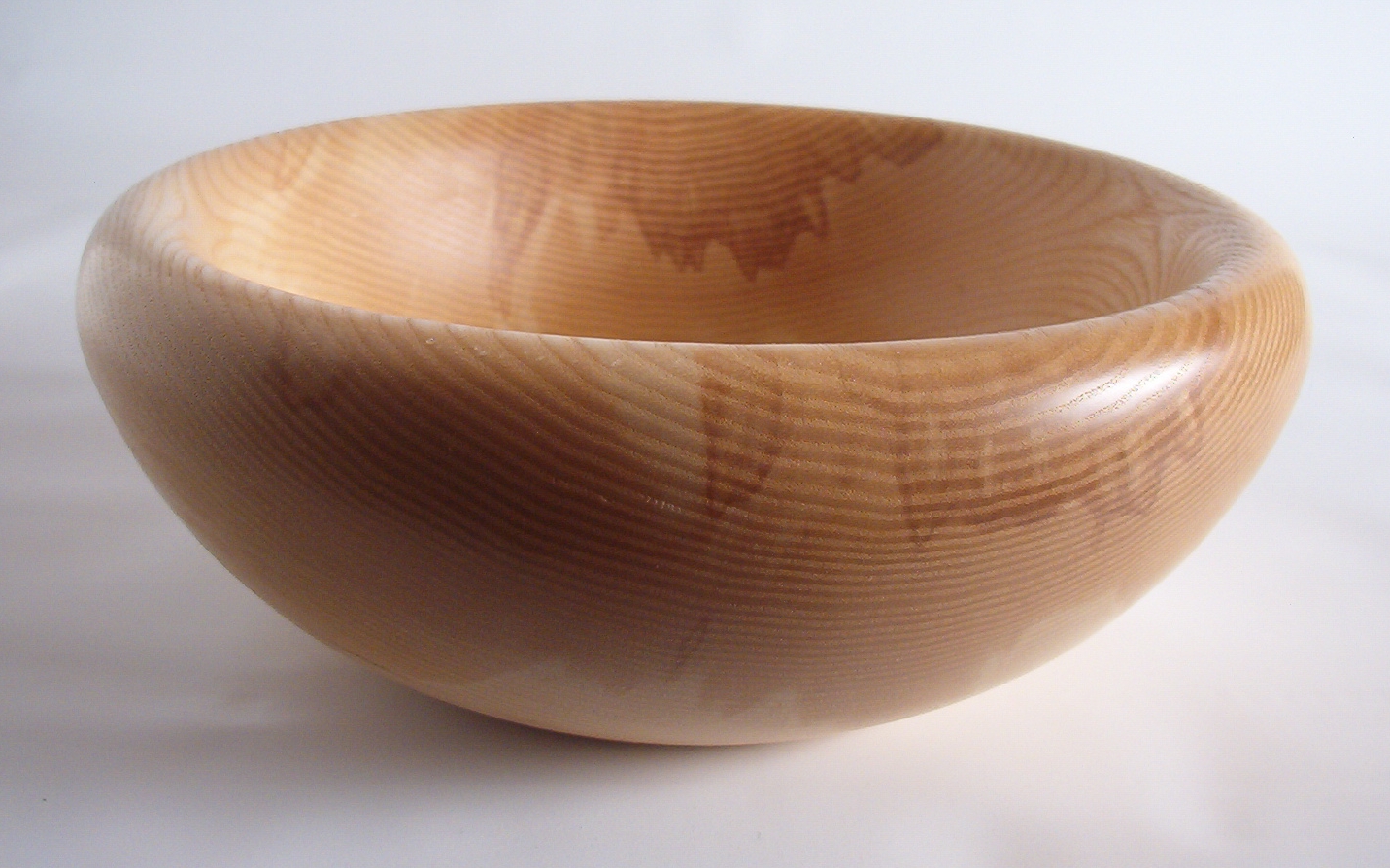
   When making wooden bowls the woodturner enters a world of creation that is thousand of years old. People have been using bowls for a long time and making them just as long. The same design questions that face the potter also face the woodturner. One of these is just how thin or how thick to make the vessel walls. Some questions need to be answered to give some guidlines.

  First of all there is the intended use of the bowl. Is it going to be functional such as a salad bowl or is the intention to be visual as an art piece? Generally, a functional bowl will be thicker so as to give stability and a sense of security. Artistic turnings may be extremely thin to give a sensation of lightness and perhaps an ephemeral quality. On the other hand a different artistic turning may be very thick and heavy to present other feelings and qualities to the beholder.
A third category may be a bowl made to impress and perhaps to impress woodturners in particular. In that case it may be so thin as to allow light to pass through the oiled wood. To make one of these, woodturners hang lights behind the turning piece and thin the bowl to allow an even distribution of light through the walls. It is a good test of skill and a learning experience.
   Functional bowls should have walls that are thin enough to work with the intention of the piece and thick enough to seem right. As a rule of thumb and eighth of an inch of thickness for every inch of diameter seems about right with a bit more for six inches and under and a bit less for bowls over sixteen inches. So an eight inch bowl might be one quarter inch thick while a six inch bowl could be three sixteenths and a sixteen inch bowl, three eighths. Most of the time the best thing to do is not to worry about the exact measurement so much as the look and feel.
   Where the bowl is to be used is also a consideration. Restaurants may have a certain criteria they want followed while a bowl turned for the outdoor deck on a summer night might have walls an inch thick. The popcorn may blow away but the bowl will still be there.
   Most of the time the best thing to do is relax and make the bowl. If the lines look good and the bowl feels right, chances are the design is good. Sometimes all the practise pays off and the bowl looks absolutely fabulous. The hunt make all the turning just that bit more special.

Friday, February 11, 2011

Beginning Woodturning: Four Tips Before You Get Started

As you look at a bewildering display of turned wood objects and an even more bewildering display of woodturning tools, it can quickly get discouraging to consider getting started turning wood at all. However if you look at the wide array of people who turn wood you quickly realizes that woodturning is an accessible hobby for just about anyone. The real question is how to get started. Here are four quick and easy ways to begin the entry into the world of wood turning and working on the wood lathe.

  1.  First take your time. Do not rush out and buy the first lathe you come to just to find out it is not suited for the objects that you would like to make. Read a few books on woodturning. Most libraries have one or two and maybe even a video to watch. It may be for a more advanced turner but will certainly give you some ideas of what you are getting into. Look for the basics such as what tools are needed and what kinds of wood lathes are available. Remember that you are starting out and all the bells that whistles that the pros like are probably not necessary for you.
  2.  Once you get a feel for the basics, consider what you might like to make for your own purposes, be they gifts, table legs for other projects, pens or whatever. Think of what accessories you might need other than the lathe or turning tools. Budgets start to come into play here. You might be able to find specialized books on your choices or even classes at the local community college or school dealing with this particular interest.
  3.  Consider taking a class in woodturning. Many woodworking classes in night school will have a lathe available and may have an instructor that knows how to use the machine. In addition look for a woodturning club in your area. A lot of communities have them and most have a fair number of watchers and even members who do not turn but are considering getting started. As a rule, woodturners like to demonstrate their skills and introduce others to the art and craft.
  4.  Stay safe as you start. Get a face shield and dust mask and use them. Hearing protectors are great too. While most lathes are fairly quiet wood shop tools, most wood turners will use chainsaws, band saws, planers, drills and the like with all the noise they provide. Safe woodworking is by far the most enjoyable.

These simple tips will get you started as you begin the interesting and compelling art and craft of woodturning. Soon you will be giving tips to someone else with the same interest.

Friday, January 25, 2008

Back to Basics


I have been working on some things for the new website in answer to questions specifically from beginners. More and more I am convinced that we need to get back to the fundamentals of turning. In some ways the direction of turning today seems to reflect the direction of education.

Our educational system in North America appears to be ranging away from the fundamentals of societal need to move toward specialization without foundation. By that I mean for example that students are preparing term presentations with video cameras before they can write a script, or for that matter a coherent sentence. Algebra appears to be on the curriculum for students who cannot handle basic arithmetic without a calculator. It used to be that employers considered a high school graduate suitable for training for managerial positions. Now they hope that college graduates can read, write, and balance a check book, but there are no guarantees. Many colleges and universities have entry level courses, mostly non credit, to teach the basic skills of reading, writing and arithmetic to incoming students, some of whom were A level graduates of high schools but lack basic skills.

In the same manner, I hear people having bought lathes to turn salad bowls for a living or baseball bats for the team, but have never used the machine before. Many a would be turner goes to the lathe for the first time, puts on a length of construction 4x4, and watches his tool be kicked over his head by a whirling menace. Fundamentals are necessary to learn and practice. The old adage of "walk before you run" works well here.

Wood turnings all work alike; prepare, turn, sand, and finish. The preparation may range easily from chainsaw and log to band saw and board or drill press and pen blank, but wood must be prepared to go on the lathe. Segmented turners will cut and glue for ages but it is all to prepare the wood to go on the lathe.

Turning may be for spindle or faceplate work but tools are still needed to be sharp and presentation needs to be clear. Different woods cut a little differently and need to be learned and approached in their own manner. Too many a new turner has been discouraged with the common spruce or pine of the flat worker to later be amazed at the nice cutting qualities of a piece of maple or ash. Each style of tool requires a slightly or greatly differing approach, but they are all able to be learned and familiarity with one makes the next easier.

Sanding is as important to the wood turner as to any other wood worker. The person who looks at the final piece looks at the surface, not the work in it. Finishing can be as elaborate or as simple as one likes, providing it fits the piece. Some call for dyes, painting, carving, piercing, pyrography or a combination of these and other embellishments. For others it would be gilding the lily.

The fundamentals well learned will let us approach that beautiful piece of hideously rare and possibly expensive wood with confidence. Learning is good.